I know I said when we left Buenos Aires that that was the end of civilisation but I don’t think the five star resort at Iguazú Falls could be considered particularly remote or off the grid – for proof look here. So I’ll say it again and with a little more sincerity, today was the day we left the city behind. Patagonia was just forming on the horizon …
We caught a flight to El Calafate, the gate to Argentinean Patagonia and on the southern border of Lake Argentino. The town reminded me of a ski village with lots of stone and wood buildings and a great number of bars. Given that its situated on the edge of one of the world’s greatest adventure destinations, most people here are in their twenties and thirties. It was cold enough that a Kathmandu puffer jacket was a functional piece of clothing and not just a fashion statement. We didn’t actually pull in anywhere at El Calafate but we’re staying there for one night at the end of our Patagonian leg.
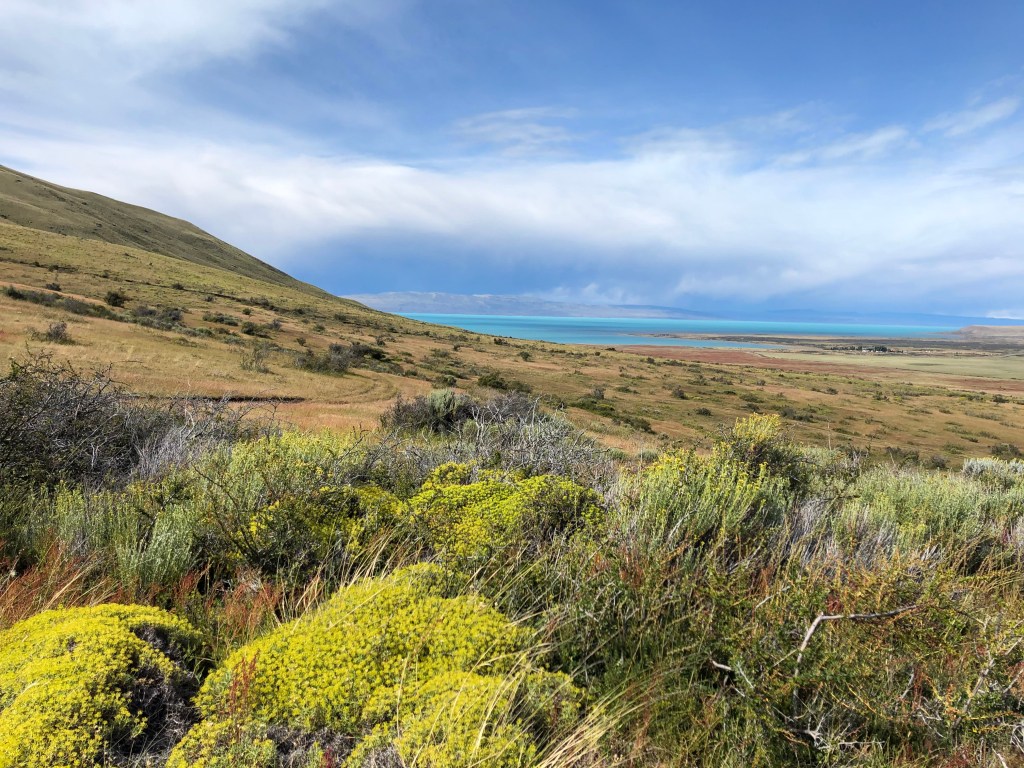
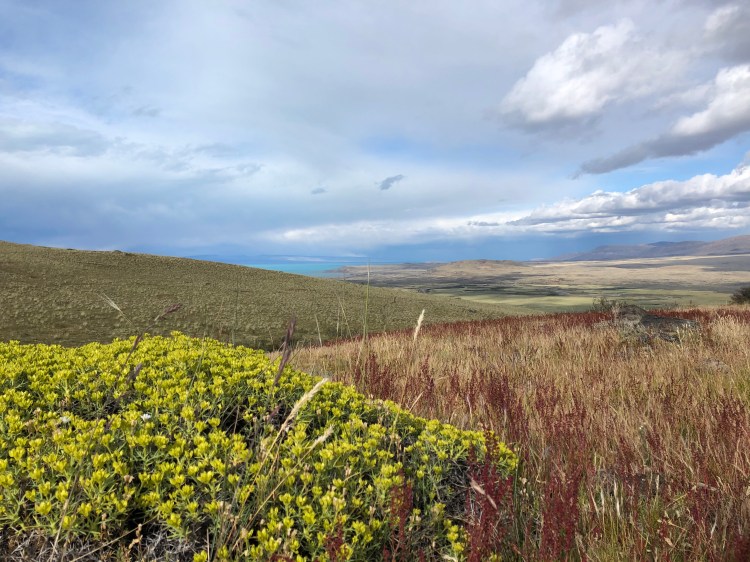
The vibrant colour palette of Argentinean Patagonia
It was almost an hour drive from town to where we would be staying but we weren’t complaining, the countryside was absolutely beautiful. It was the polar opposite of the jungle at Iguazú, a lush and somewhat crowded place. Here, huge sweeping plains were sheltered by tall mountains. Out of the corner of one eye I could spot the snow-covered Andes and from the other I could see the milky turquoise water of Lake Argentina. The grasslands between them are called the pampas and are an earthy mix of browns, yellows, oranges and reds. This was a certainly a change from the drought and fire stricken countryside of Australia.
We arrived at EOLO, which would be our home for the next couple of days. The homestead we moved into is part of a Poll Hereford cattle property called Alice. This estancia was relatively small for the area but still spanned an impressive ten thousand acres. I’ll sneak in a few pictures but the building really looked like a typical Western farmhouse and had amazing views of the countryside from every window.
EOLO – our lodge on the estancia ‘Alice’
Something that took me by surprise was the sheer amount of daylight hours we would have. We anticipated that since we were fast approaching the Antarctic circle that our sunsets would be later but we weren’t prepared for light until 11PM. Even though our bedrooms had heavy duty black-out curtains, we were certainly disoriented for our first day so it was a relief to stay at the same place for at least two nights.
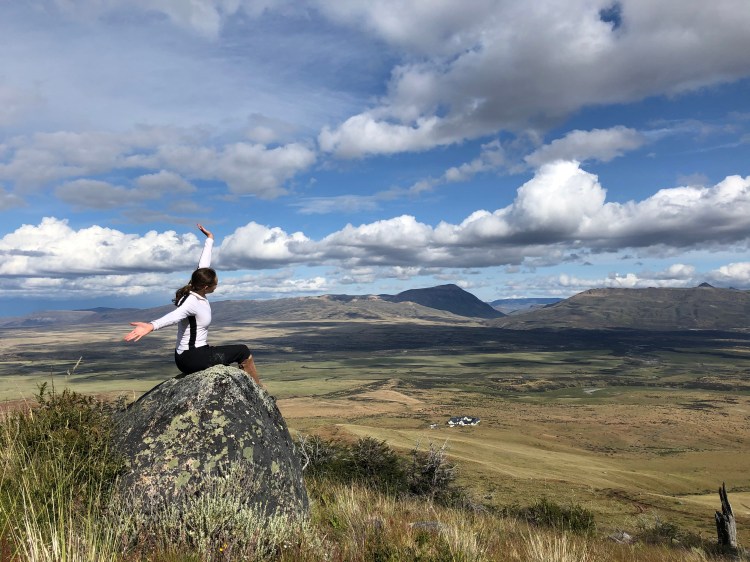
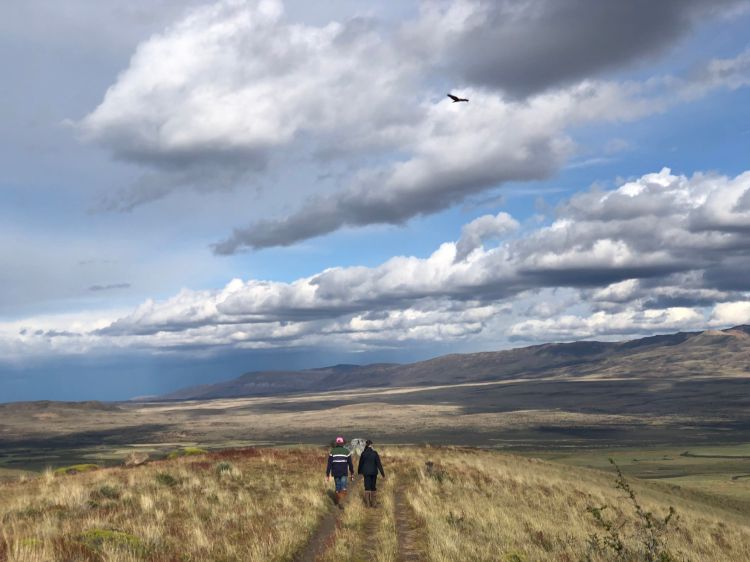
The upside of this was we still had plenty of time to go on a short hike. There are a couple of huge hills – small mountains according to the staff – directly behind the lodge. We had a good chance of seeing wildlife including guanaco (Patagonian llama) in the forest at the summit here. It was a steep climb but it gave us some awesome panoramic views. Out of the corner of one eye I could see the vibrant Lake Argentina and from the other were the dramatic mountains. EOLO really was tucked into the pampas here and we really felt more connected with the world around us. We didn’t have much luck spotting any guanaco but there were plenty of large hares darting around in the thicket and various eagles, condors and other birds of prey gliding in the wind. Come to think of it, it was such a steep climb perhaps they were waiting for us to keel over.
By 7PM we were over at the estancia’s stables for a quick ride before dinner. As we grew up with horses we tended to avoid these excursions on holidays because they felt like tourist traps. But this was an entirely different scene. We felt like the traditional gauchos wearing our big leather chaps and sitting in a Chilean style saddle. It was a very easy ride and although we were only walking it was a great chance to take in the scenery from a new perspective. We traversed the hills, the cliffs and the valleys and over a few hours we had covered a lot more ground than what we had hiking that afternoon. However, our lodge in Chilean Patagonia offers a greater number of rides and caters for all levels of ability. I’m certainly looking forward to galloping across the pampas!
Horse riding with the Andes in the background
It was past 10PM by the time we reached dinner but the sun was still shining. The food was amazing and beautifully presented, it really showcased the best local steak and lamb. We were even lucky to see a typical gaucho style slow-cook BBQ at the back of the kitchen. The small smoke room was made of corrugated iron and had been cooking a lamb on a spit for the past five hours. It smelt and tasted divine, especially alongside a glass of Argentinean Malbec!
We were so excited to arrive in Patagonia and dive back in to our family’s typical wild adventures. There was a big day coming for us in the morning when we set out to climb the Perito Moreno glacier – look out for the next post, its sure to be one of the best!
Before we crossed the border into Brazil we had always been loyal to Argentina and their perspective of the falls. We’d hiked all three trails there and remained firm in our belief that it was superior as it was home to the only resort with views of Iguazú . We still think it was a better idea to hang out in Argentina but the more I look back on my photos I realise that perhaps Brazil was far better than we supposed. Maybe it was the weather, maybe it was the time of day … head over to Instagram and decide for yourself!
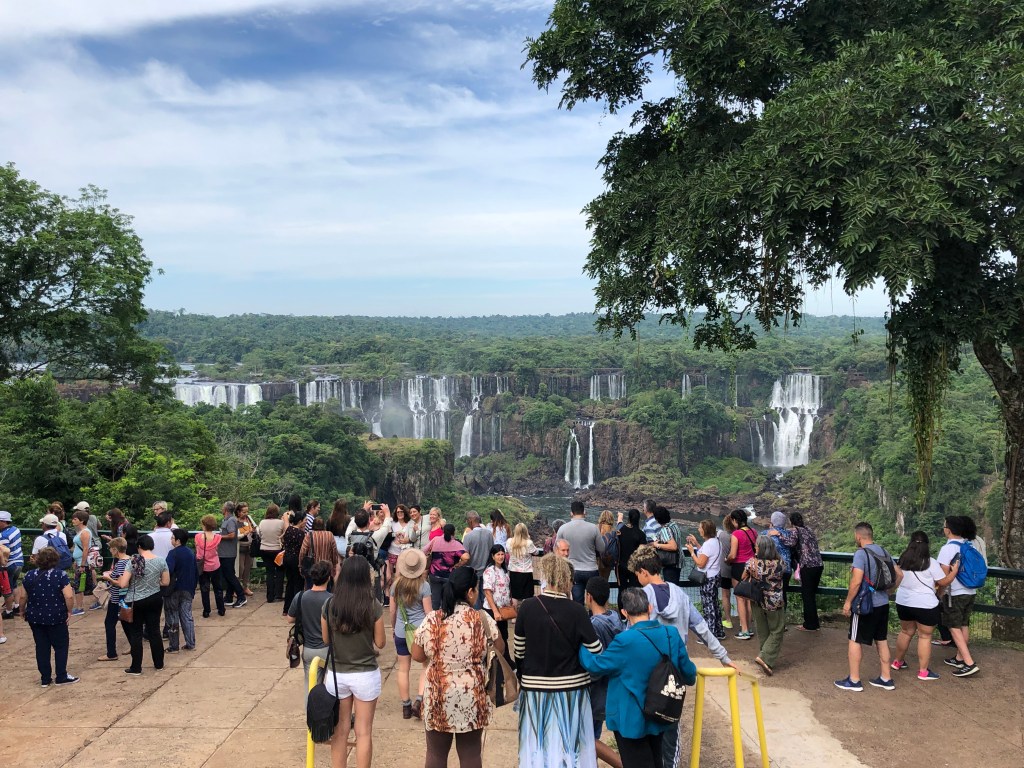
Our guide Deborah picked us up early in the morning and our van beetled its way towards the Brazilian border. By departing before 8AM we’d greatly reduced our risk of getting caught in immigration traffic and maximised the time we could spend at the waterfalls and the famous Bird Park.
Arriving at the falls during the ‘quiet’ period
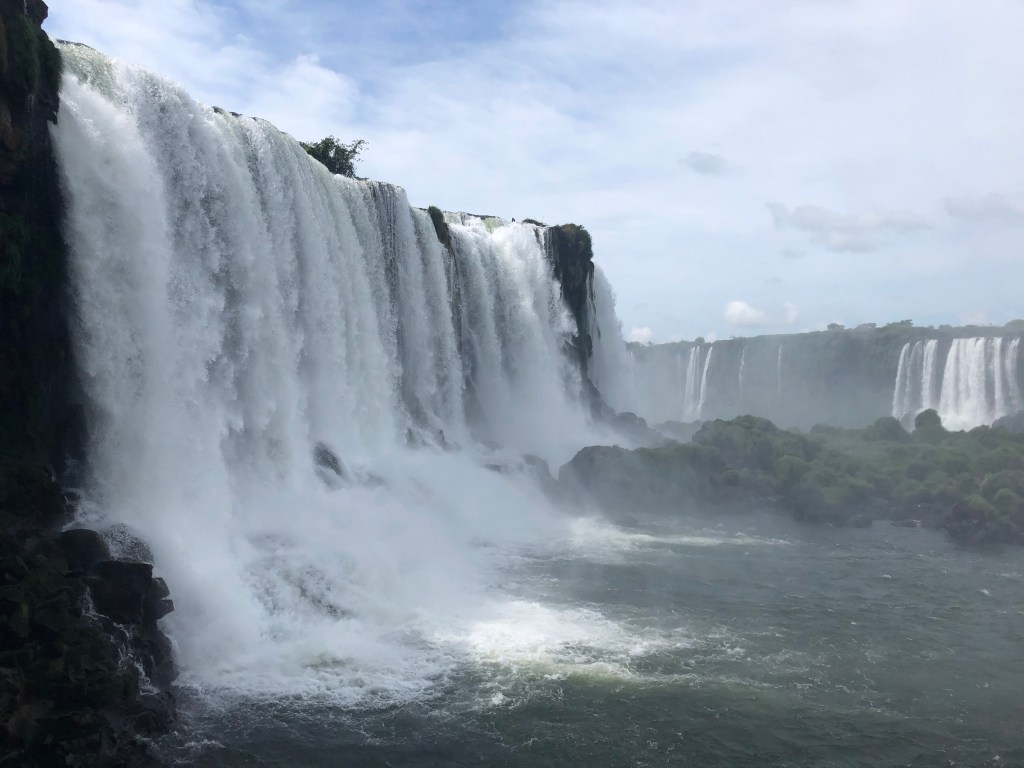
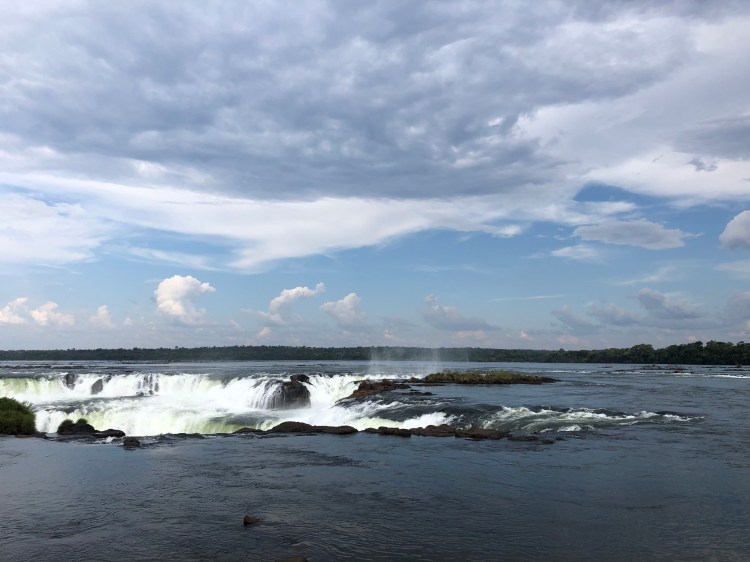
By late morning we arrived at the falls and were only slightly shaken by the bumpy van trip there. Deborah clearly knew what to expect and pointed out the start of the trail. We were like kids in a lolly shop. Photos here, amazed expressions there, very small crowds and a handful of Australians living with water restrictions gazing at one of the lushest scenes you could concoct. There was a board walk over glassy water that lay metres from the feet of the largest falls. It was such an odd sensation, like two worlds colliding. You could hear the roar of the water and feel the mist clinging to your skin but the river beneath your feet was perfectly tranquil. We followed the raised platform out to the Devil’s Throat which highlighted the drama and the sheer size of Iguazú. Just like Argentina, we were dripping wet within seconds. This was one of those occasions when wearing active wear was acceptable.
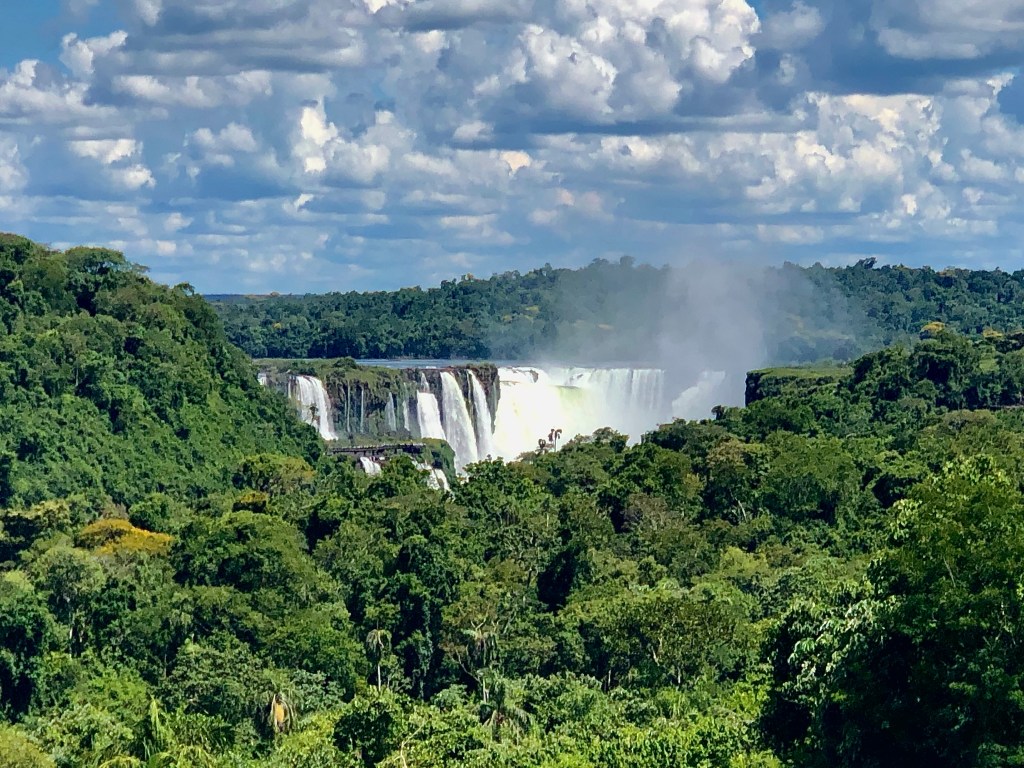
The gushing Iguazú Falls from the Brazilian border
These photos definitely support a visit to the Brazilian border but in order to get a complete picture of Iguazú you really need to visit both countries. Argentina was fantastic for getting close to waterfalls beyond the Devil’s Throat and for seeing wildlife. Our hotel meant we were constantly in amongst the action and could afford to start hiking early in the morning and late at night. The Argentinean half has three trails which are all loops, immediately giving you more variety and ensuring all the pedestrians travel in the same direction. Brazil was a little more chaotic and we found ourselves having some bizarre international conversations with other tourists about the absurdity of the crowds. There was just one track here and it doubled back on itself despite the fact it was only wide enough for one person. However, with the beauty of the falls, we summoned some skinny thoughts and made our way through alive. The Brazilian side was also fantastic for getting a feeling of the expanse of Iguazú. We could see across the cliffs to wide expanses of water just pouring over the side. Small dots of tourists walking the Argentinean trails were also visible and gave us a greater sense of perspective.
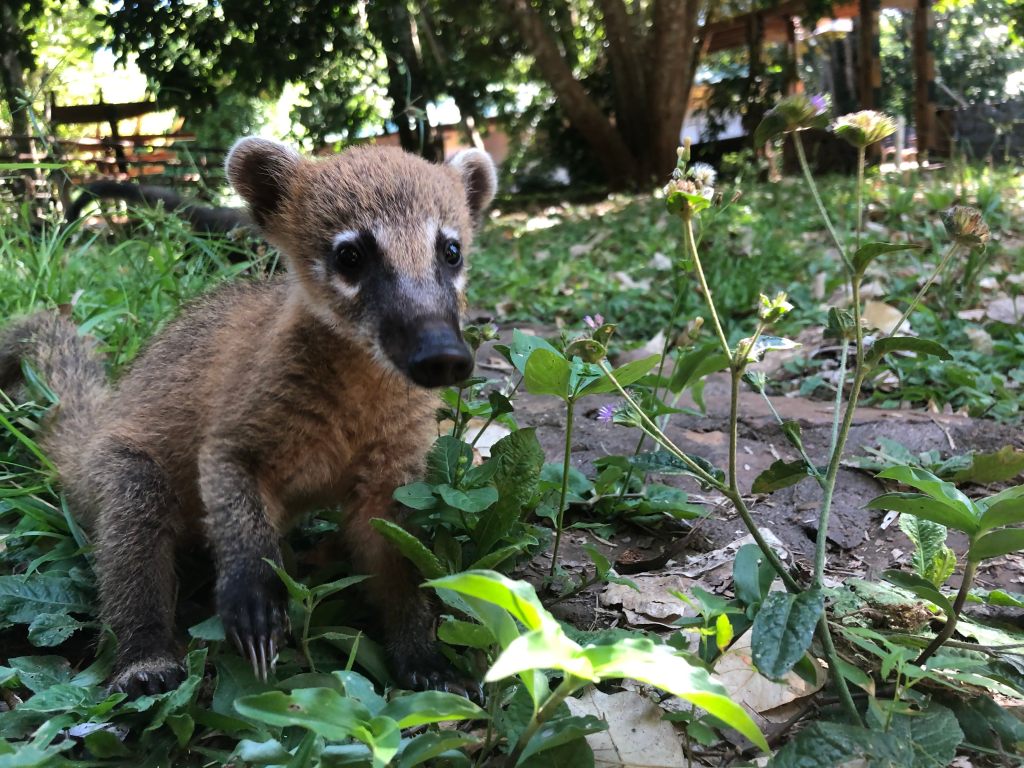
Don’t worry – both sides have coatis that are equal parts friendly and curious. It was very hard not to touch one!
Our guide Deborah looking displeased with a cheeky coati as tourists look on
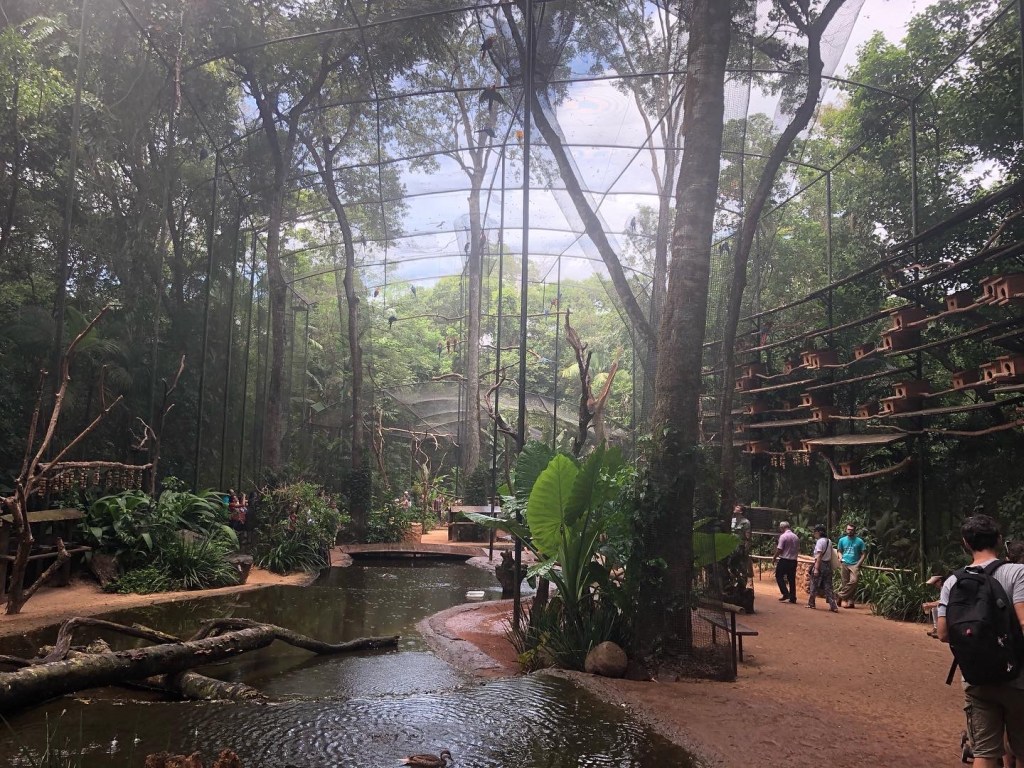
A couple of hours later we emerged from the Brazilian trail to our guide Deborah who looked mildly relieved to see that we had survived the tourist photo war waging on the viewing platforms. We jumped back in our van and pulled into the Brazilian Bird Park. I’d heard some rave reviews about this place so I was keen to step into the aviary and make some feathered friends.
I quickly realised this was like the Hollywood Hall of Fame for birds. Many of the most prominent bird species from across the world were represented here. Rather than being organised according to continent, they were grouped by similar habitat and ecosystem features. Without entirely discrediting any birds, it’s safe to say that the park was organised to save the best for last. First we walked through large open aviaries with moorhens and ibis, then eagles, parrots ad toucans and finally the vibrant macaws South America is so well-known for. Throughout our visit the park was dotted with numerous signs that outlined their approach to combatting wildlife trafficking. One statistic was particularly shocking: more than ninety per cent of illegally trafficked birds do not survive. I found this quite upsetting as most people – including myself – are concerned with the poaching of macaws, but most of the birds who are sold at black markets are smaller parrots. The park not only works to demonstrate the beauty and variety of bird life worldwide but also to educate the public about how to identify illegal trafficking and take action against it.
A curious scarlet ibis and a toucan
The park’s grand finale was a huge open air aviary filled with noisy macaws that flew to each side with great energy. Poles at the top of the aviary were fitted with sprinklers so it appeared to be raining the whole time. Although we couldn’t see that many of the birds close up, it was easy to recognise just how varied and colourful they can be. Most people think of the ‘usual’ red or blue macaws, but within this area there were at least half a dozen seperate species. When we left the aviary we strolled through the butterfly house which was dotted with bright wings, flowers and fruit.
The macaws’ grand suite
This may have been the conclusion of our formal activities for the day however we had plenty of travelling left to do. We crossed back over the border and caught a flight to Buenos Aires for the night. Our original itinerary planned to avoid us doubling back like this but unfortunately South America’s flight times are subject to change until the very last minute so this was our only option. We pigged out at a local parilla or steak house near our hotel in Palermo and prepared for another flight tomorrow morning to El Calafate … bring on Patagonia!
In the wee hours of the morning – realistically about 8am – we left civilisation as we knew it in Buenos Aires and flew into Iguazú Falls. We spent three days staring in awe at one of the largest waterfalls in the world, two from the Argentinean side and one from the Brazilian. Our itinerary was so packed over this time that this post is arriving a few days late but here is a quick recap on our adventures from the Argentinean border.
I was told our hotel had a fantastic view but I was not expecting this. Walking through the front doors of the Gran Meliá you’re immediately greeted with an uninterrupted view of the gushing waterfalls and rainforest. There’s even an infinity pool outside that will let you get the perfect holiday shot to post on Instagram if that piques your interest further. Two hotels operate within the National Parks here, one from the Argentinian side and one from the Brazilian. However, the Gran Meliá is the only resort that provides you with a direct view of the falls, including from your room!
Our view of Iguazú Falls from the hotel
The difference in climate between Buenos Aires and Iguazú was quite significant as we’d been snatched from a hot dry city to a humid rainforest. We could see a constant cloud of mist floating up from the falls and this was only a hint at what was to come when we got closer. Even though all the walks on offer would take us an hour or two, we would usually find ourselves in the pool with a drink at the end of the day – perfect.
It was a two hour flight into Iguazu from Buenos Aires which gave us enough time to walk one of the three circuits on offer. The advantage of staying right at the falls meant being able to step outside right as the park opened or as it was closing when the crowds were low. Our guide recommended we hike the Upper Circuit that afternoon as most tourists will be preoccupied with the famous Devil’s Throat. As I’m writing this after our visit I can definitely say this was the best approach and kept us out of the way of an infinite number of Go-Pros, selfie sticks and family photos.
The Upper Circuit placed us at eye level with many of the ‘smaller’ falls (they were all very impressive) that frame the Devil’s Throat and curl around the cliffs. There were other people on the trail but it was fairly quiet, everyone understood how important this place is. The rainforest was such a vibrant green and a very welcome change from the harsh droughts and bushfires in Australia. The roar of the falls would get closer every minute and it became second nature to point out the next rainbow. The Upper Circuit guided us past many waterfalls and across the Iguazú River before ending at the powerful Salto San Martín. Every track is accessible by wheelchair and new offshoots from the main drag are being added regularly so everyone has the chance to see as much as possible. It was beginning to get difficult to limit the number of photos I was taking, let alone delete any, as there’s picture-perfect scenes in every direction.
Views from the Upper Circuit
We were incredibly lucky with the wildlife we saw from the Argentinean side as well. We’re animal people so you might be able to imagine us walking around with binoculars in our hands and getting excited about spotting a colourful butterfly or bird. What we didn’t expect – and later learned to be an exceptionally rare encounter – was spotting a capybara! These guys are the largest aquatic rodents, very smart and very social. On our 2018 trip with Classic Safari Company to the Peruvian Amazon we had counted ourselves lucky to see a small group from afar. However, this individual was particularly calm; totally unphased by tourists and the possibility of hurtling down over the edge of the waterfall. Over the course of these two days we also spotted a wild toucan, a caiman, lizards the size of goannas and plenty of colourful birds and insects. A tribe of monkeys had moved in next to the hotel so we often caught them trying to open our balcony doors as they had learnt to go straight to the mini bar!
The coatis (pronounced co-ah-tees) may have been shrugged off as pests by the staff but these little mammals were certainly our favourites. In the evenings as we returned from our last activities for the day we would spot a few coatis emerging from the bushes, then pairs of juveniles, then whole families until the track would be home to several dozen of the little things. Their long noses give them a very strong sense of smell so they were keen to sniff any backpack they could get near – a secret trick for close up photos! There was never any aggression between tourists and coatis and they understood that if a backpack was out of reach then they’d have to move on. They certainly had enough food already as the citrus trees would drop plenty of fruit for them.
Coatis, capybaras and monkeys galore!
We were able to sleep in until 7AM the following morning (very ironic) and walk the Lower Circuit. We’d successfully dodged the crowds, most of whom were travelling from outside the National Park and heading straight to the Devil’s Throat. This was a good tip from our guide and also saved us from the intense heat and humidity that sets in as the day progresses.
The Lower Circuit, directly translated from Spanish as ‘Inferior’, was arguably the more impressive trail around the falls. We were the only people around for most of the morning so we could peacefully wonder through the rainforest and shamelessly grab the occasional selfie from the viewing platforms. This circuit placed us at eye-level with individual streams of falls as well as larger sheets and sections of Iguazú. We had great views of the forest which culminated with a viewing platform right at the base of part of the Salto San Martín waterfall. I was learning that waterfalls are not easy things to photograph and yourself and camera will be dripping in mist within seconds!
The final lookout on the Lower Circuit
Later that morning we were booked in for a jet boat ride around the river. We were loaded into a small roofless Jeep and bounced over a narrow track through the jungle to reach the shore. Everyone was encouraged to take their shoes and socks off and store them in the waterproof tarp bags handed out to us. We thought this was complete overkill for the brief spray we’d be receiving from the falls but we went along with their suggestion. Our fellow passengers had taken the seats at the back so we grabbed spots right at the front. Little did we know how wet we would get and how important that waterproof bag would be …
The boat flew over the water, spinning round corners and pulling up in front of some spectacular waterfall views. I thought I was pretty clever putting my phone in a plastic ziplock bag to keep it waterproof and at that point it was sufficient. The driver directed us over to a few curtains of water and prepared us to get soaked. Yeah right, we thought, some heavy misting.
Before we were all drenched under the waterfalls!
The driver nudged the nose forward, another staff member took out a GoPro, everything went white and the whole boat screamed. We were absolutely drenched! The falling water was so heavy it was difficult to imagine how little sparrows and swallows dive in and out of it every day. Everyone yelled for an encore and we went through the whole procedure several times. I was realising my phone probably wouldn’t survive in its cheap ziplock bag so I hurriedly slipped it into the tarp satchel between dunkings. This was also one fo the first boats to go out in the morning and a good way to keep cool as the humidity set in. We’re not usually one of those families but we thought the Go-Pro video must be hilarious so we bought a cop. I recommend bringing a bottle of water and some pesos with you to save yourself from more expensive charges in US dollars for the boat ride.
In the Jeep on the way back
We quickly dried off on the trip back in the Jeep and readied ourselves for the last adventure of the day, a train ride to and walk around the Devil’s Throat. The station was well within walking distance from our hotel and built specifically for the small slow open carriages you might see around zoos. A few coatis hung around expecting a snack. We caught one of the last trains of the day, an option that isn’t available to most people staying outside of the park as they will have to travel at least one hour to the National Park. So again, we had missed the crowds and the very worst of the heat. The boardwalks are never longer than a couple of kilometres but you’re easily slowed by other tourists and the sheer beauty around you.
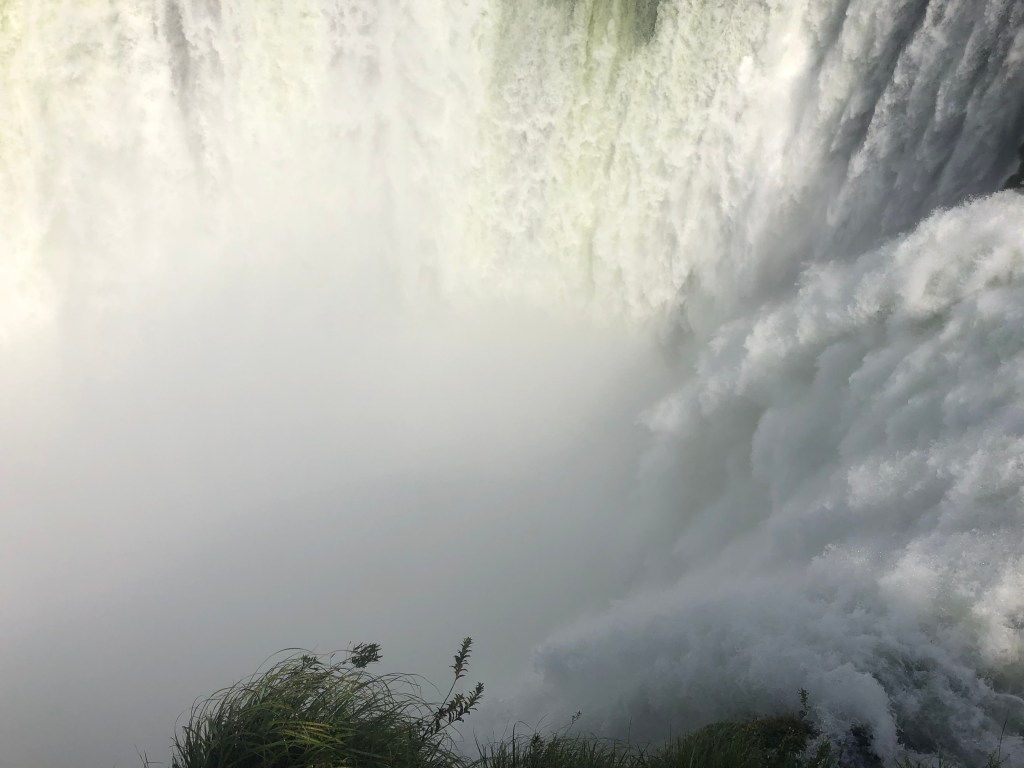
After two days of being soaked by waterfalls, I still thought my phone would survive outside the ziplock bag. It was certainly fine when we walked through the rainforest and across parts of the river that were so still you could see your reflection in them very clearly. Just a few metres away from this tranquility was the Devil’s Throat. The noise it made was unbelievable, it just thundered without relent. The sheer quantity of water pouring over was impossible to comprehend and it all seemed to disappear into a white cloud of oblivion. There was rainbows too and we could see smaller groups of falls winding round the cliffs from the Throat. The power of this waterfall certainly meant it could release some mist – within seconds we had to wipe the water from our faces to see clearly. My phone lasted a few minutes before I stowed it in the safety of my backpack. Sometimes its best to forget the camera altogether and really tune in to what’s happening around you. I was just as likely to drop it over the edge anyway.
I’m writing this post from Chilean Patagonia where the wifi isn’t fantastic and we are hiking most of the day and evening as it doesn’t get dark until 11PM. I’ve uploaded plenty of photos and videos of the best waterfalls from the Argentinean side on Instagram as I’ll be restricted as how to much I can post here. I don’d think I would be particularly popular in the lodge here if I blew the Internet! Look out for the next post recapping Iguazú Falls from the Brazilian side, coming to a screen near you soon …
In the build up to this trip we wondered if we were cutting our time in Buenos Aires short as we had scaled back our days there from four to three. Despite the fact we are away for a whole month we stuck to our adventure travel roots and prioritised our time in Patagonia and Antarctica – coming soon and likely earlier on Instagram than here! That being said I think we spent our three days extremely well and haven’t come away feeling like we have missed out. Buenos Aires is such a dynamic city its pretty hard to complain.
The key to travelling anywhere as a tourist is to anticipate the movements of other foreigners and do the opposite. Most people like to sleep in and have a relaxed breakfast at the hotel – we prefer to get up early and beat the crowds and the heat. On our last morning we headed to Recoleta Cemetery, a few minutes walk from our hotel.
Not many cemeteries are top drawcards for tourists or locals but Recoleta seemed to be the dead centre of town. I don’t think I’ve ever visited a cemetery with a bustling market just outside the gates and tour guides hovering to show you around the best graves in the city. Recoleta is home to the mausoleums of some of Buenos Aires’ most wealthy citizens, many of which have been buried there for generations since its opening in 1822. In fact, people are still laid to rest there which I found surprising as its flooded with tourists every day. Some of the inhabitants may have moved in fairly recently but the designs of each mausoleum are generally quite traditional and reaffirm that likening to Paris. There are innumerable rows of graves, all of which are quite tall and transformed the place into a giant maze. With my lack of a sense of direction I’ll admit I did get lost a couple of times once I’d left the main drag. But, I reminded myself, don’t worry if you get lost, people are dying to get in here. Enough puns.
Getting lost in Recoleta Cemetery
Many sites were beautifully decorated with inscriptions, carved angels and crosses. If they hold a family there was often a set of stairs from inside the tombs that led to a crypt underground. This also prevents any chance of grave robbing. A few men were busy scrubbing their facades and carrying out general maintenance work. I’m not a religious person but it was a very reflective space. Recoleta may be another display of wealth in Buenos Aires but also of faith and their approach to mortality. Families are willing to fork out tens or even hundreds of thousands of dollars to secure a place to lay their family members to rest. As a tourist I often found myself searching for the grandest grave for the best picture. I had to stop myself a few times and remember each of these corresponds to at least one real person who had their own life. Recoleta was more a space for cultural education than impressive sightseeing for me.
The pinnacle of this came with a group of American tourists. Our family had reached the tomb of Eva Peron, President’s wife at the time and a famous political figure in her own right who I have written more about here. The Americans had organised a tour guide who announced which mausoleum Eva was buried at. One group member turned around and asked “Who is that? Is she famous?” After Eva passed away from cancer in 1952 her remains were displayed across Argentina and abroad for two decades before she was buried with her family. With much quiet laughter on our end we continued our morning stroll through Recoleta. We saw graves of past Presidents, army and navy generals, members of Napoleon Bonaparte’s family and Nobel Prize winners.
I highly recommend visiting Recoleta Cemetery, of course it is a photo opportunity because of the overwhelming grandeur of the place but its also a chance to consider Argentinean culture. We didn’t organise a guide but we did research some of the sites beforehand. Although if you are visiting I would recommend joining a tour as they can give you the most relevant information and ensure you see the ‘most important’ graves at Recoleta.
Eva Peron’s inscription on the maiden family’s mausoleum
After a rather sobering morning we stepped outside the cemetery gates and into the Recoleta market which are held every Saturday. The stalls were a real mix that appealed to tourists as well as locals. You could find anything from classical fridge magnet souvenirs to handmade leather belts right up to expensive silver jewellery embedded with Inca rose, Argentina’s national stone. The stalls snaked around the park – there must have about one hundred of them – and plenty of lcoals sat out on the grass with a thermos filled with maté, a very very popular bitter tea drunk from a gourd. Smaller clusters of tents sold fresh produce or artworks. This was a perfect opportunity to find many of the souvenirs and presents we had been planning to buy. Buenos Aires was our only real chance for shopping on our trip because I’m fairly sceptical of any shops existing in Antarctica.
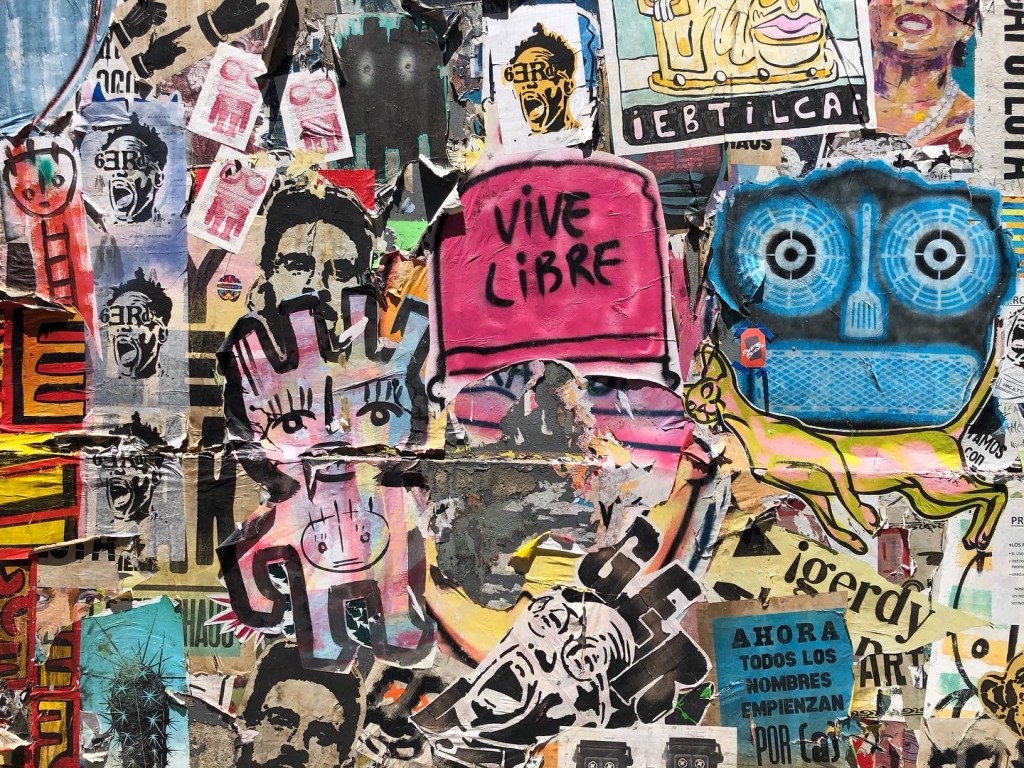
We had lunch at a pizza joint in Palermo, the largest suburb in Buenos Aires. In fact its divided into smaller neighbourhoods such as where we were in Palermo Soho. If I could liken it to an area in Sydney it would be Paddington’s Queen Street. Both areas are filled with sycamore trees and exclusive boutiques. However Palermo Soho has a bit of Melbourne in it too with plenty of shops, streets and back alleys decorated in bright street art. We decided to take a break from eating empanadas and finally found a pizzeria. We’d heard Argentinean pizza was heavy on the cheese and that was pretty accurate. Like drinking maté and eating crumbed steak, I think its something I’ll only be eating once!
In an attempt to work off all that pizza we walked around Palermo for a little longer before we jumped in a taxi back to the hotel. Mum and I made a last minute visit to the San Telmo antique markets to buy a penguino – arguably our best souvenir because it holds wine – and a Fileteado style sign. As we walked back to the hotel we swung by Cafe Tortoni, famous as it was popular with top tango dancers. The line to get in was far too long and I expect it always is.
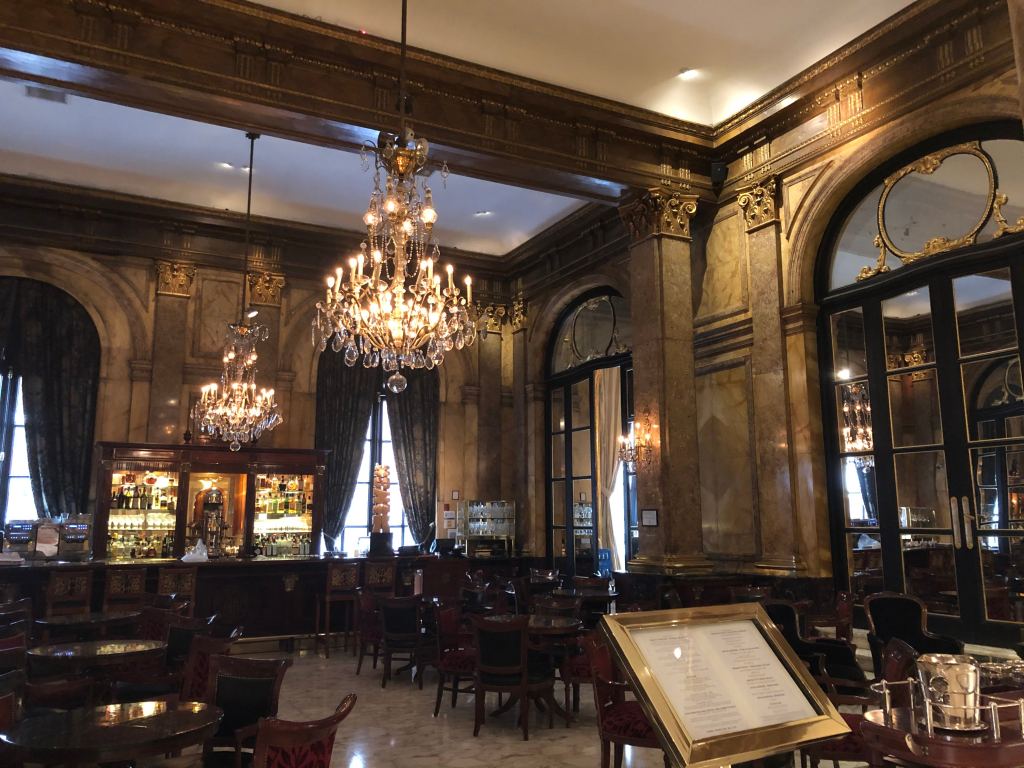
Our last dinner in Buenos Aires was at the hotel’s restaurant Alvear Grill. We had a drink at the bar downstairs which is framed by decadent marble pillars and gold detailing then headed in for steak like true Argentineans. It was a certainly a full three days but we did it comfortably. I definitely could have looked around for another day or two and visited an estancica in the countryside, the Sunday markets in San Telmo or the colourful houses of La Boca but as is the traveller’s way, we must move on.
By Day Two we felt pretty acquainted with the bustling city so we decided to step it up a notch and explore the islands nearby. We’d managed to see most of the major sites the previous day so we jumped in a car with our guide and headed out to the Tigre Islands. Safe to say that it was fairly relieving to ditch the chaotic traffic and step into a canoe!
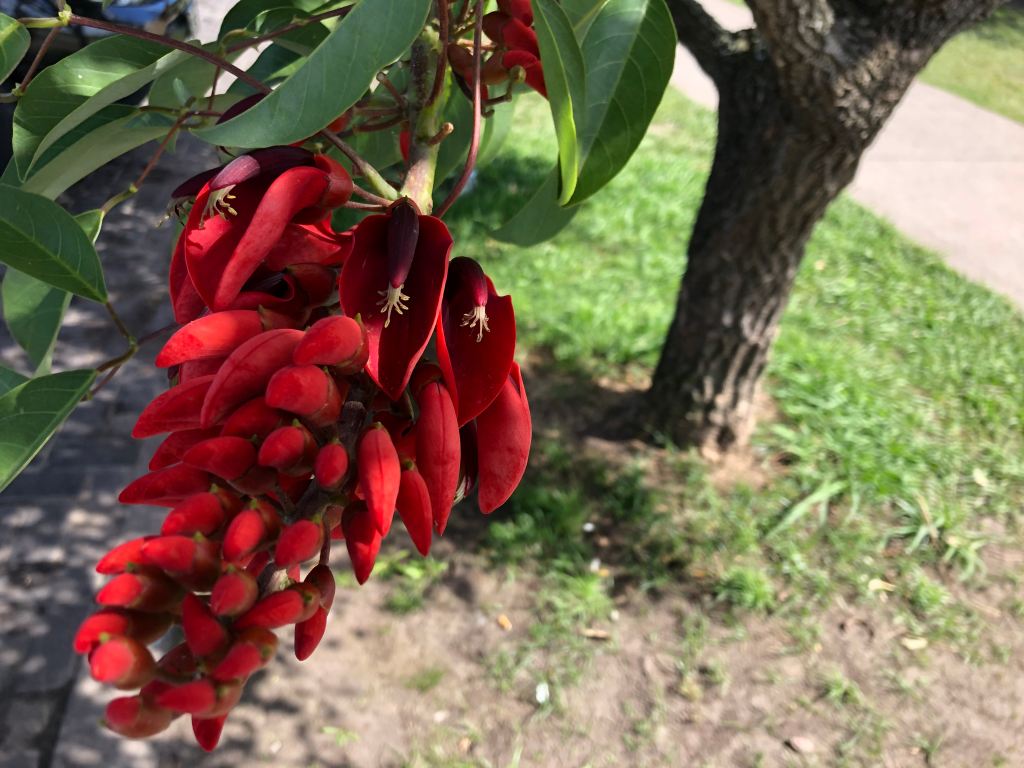
Leaving Greater Buenos Aires (the city) behind, we drove for an hour to Tigre which is part of the Buenos Aires Province. Along the way we stopped to grab some photos of the Río de la Plata, a river with an identity crisis. It does flow with freshwater but in parts its wider than two hundred kilometres so you’re unable to see the other side. I think makes it a pretty strong contender to be reclassified as an ocean. The park here was filled with sable trees whose red flowers are the national flower of Argentina.
Sable tree flowers
We regrouped in our little car and drove through streets lined with old mansions, many of which are weekend and holiday houses. At the other end of the spectrum are the smaller simpler houses of permanent residents. The disparity in wealth here was pretty apparent and it wasn’t unusual for a whole street to hire security guards with watch towers outside.
When we finally pulled into Tigre we learnt a couple of things:
‘Tigre’ was the name given by the Spanish who actually saw a jaguar – zero relevance to tigers at all.
Australian rowing sheds are behind the eight ball in terms of architecture.
The streets here and across the water primarily contained rowing sheds and a few fancy restaurants. What was most surprising was that each rowing club was perfectly housed in its own mansion or palace along the main boulevard and were all established social hubs. I don’t know much about Argentinean rowing but it would be tough to think of a better place to be. By the time we had arrived most of the slick competitive boats had left the water and we entertained ourselves by gawking at a few archaic models challenging the boats and their wash.
Left: Rowing boat in Tigre. Right: La Marina Rowing Club
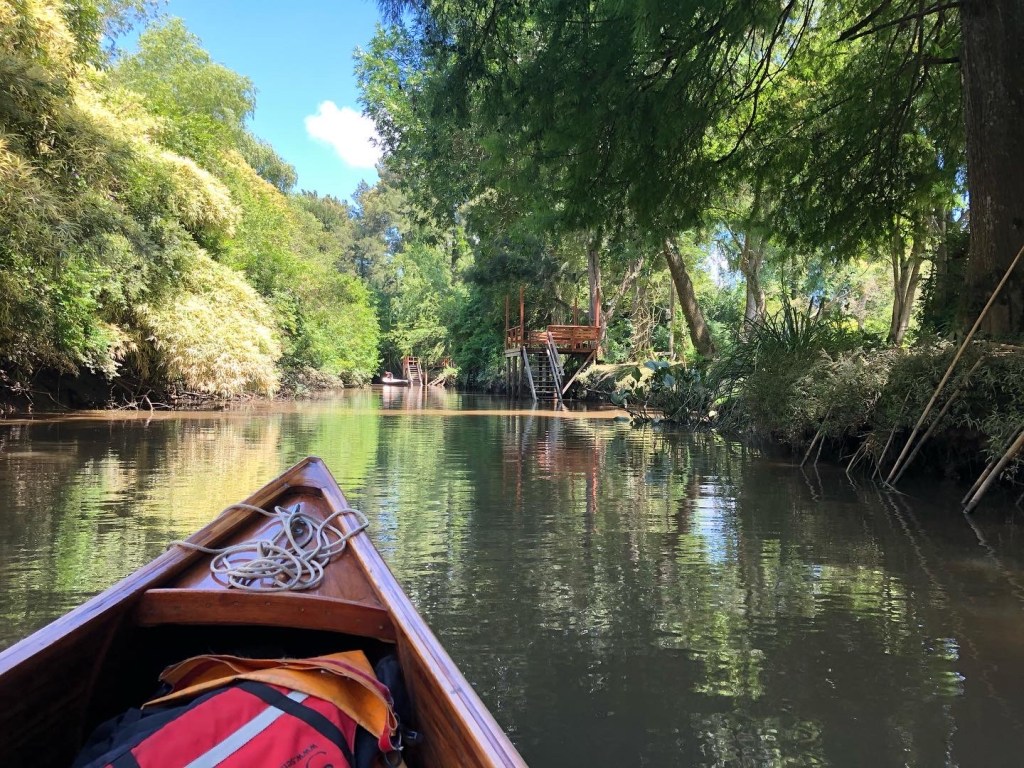
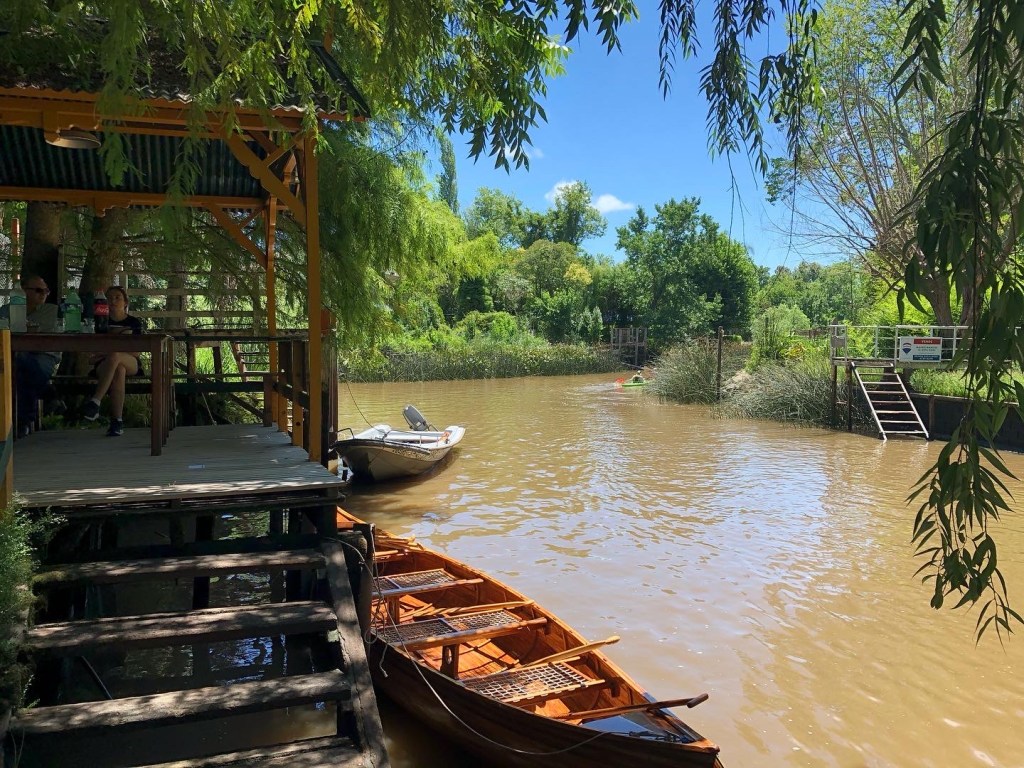
Our canoe had been handcrafted from wood and painted with an indigenous design – absolutely beautiful. We quickly found our groove and paddled dragon-boat style away from the port and towards the islands. When we asked our guide Romeo how many islands we were approaching he laughed at us, “Too many! Impossible!”. It was only when we arrived that we realised that it would be entirely impractical to count them as most houses were on their own island and separated from their neighbours by a tiny stream.
Many of these houses operated as weekenders too but were far less extravagant. The permanent residents operated boats that sold groceries door-to-door, collected garbage hung on bamboo poles from the riverbank and even a floating ambulance. Some houses had a small whirring generator but most went without. Living there would be a never ending adventure I’m sure. I’m not quite certain if I could pull that off full-time – the phrase ‘alternate lifestyle’ was mentioned fairly often – but it was a great day trip!
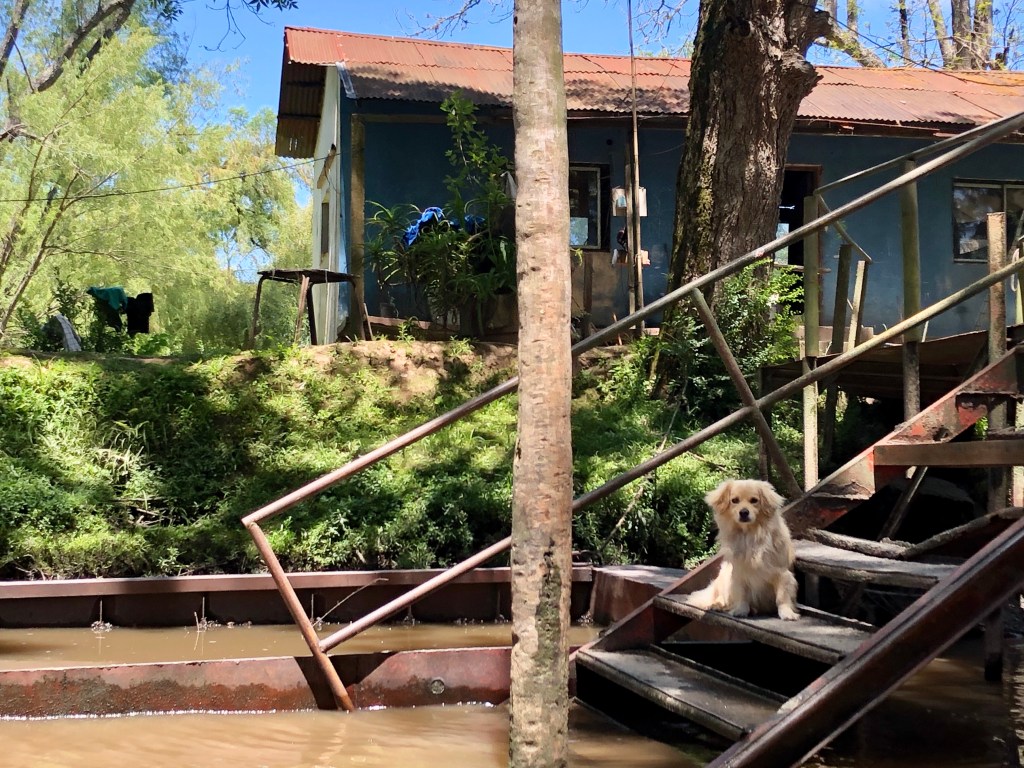
Dog days in Tigre
On the upside, the islands are free from any nasty animals like caiman, snakes and wild cats – very surprising to any Australian and anyone who has ever imagined what dangerous creatures roam the jungle. Small island size and apparent safety meant many families left their dogs at the islands and either relied on the neighbour to feed them or for the dog’s hunting instincts to kick in. It was a hot and humid day with plenty of boats on the water so we were very happy to see lots of dogs wagging their tales at us from their jetties.
A couple hours of paddling had passed and I could sense the mounting sunburn on my nose so we pulled in for a quick refresher at the canoe craftsman’s house. We learnt it took two months to construct one boat which sounded fairly fast to me. Each paddle was also handmade and a small shed housed all the surplus canoes and equipment.
Our mighty boat handcrafted by Lucas
Romeo directed us through a shortcut back to Tigre and it was quick trip from the port to our hotel. We had dinner at a local joint with wine barrels strapped to the ceiling and small leather booths. While my Spanish may not have lived up to the expectations of the local waiters, it was great to escape the major restaurants and dine with the Argentinians – we are in their country after all. One ‘delicacy’ or popular dish here is Milanesa or breaded steak. The best way I could describe it is to imagine a typical Australian parmigiana but filled with steak. It was definitely a mouthful but I always make sure I’m ordering what the locals enjoy wherever I travel.
Travelling beyond the city limits was refreshing and exposed us to seperate ways of living here that could not be possible in metropolitan areas around the globe. I really enjoyed having two such distinct days back to back as the variety held my interest. My next post ‘Day Three in Buenos Aires’ was packed with unique experiences again – Recoleta Cemetery, Palermo’s boutiques on the edge of the city and artisanal markets in Recoleta and San Telmo.
Here I am writing about the very first day of our adventures in Buenos Aires more than one thousand kilometres away from the city … I’ll admit that I knew I wouldn’t be posting daily updates, but I thought I could have blamed it on poor wifi instead of poor time management and my preoccupation with Instagram. So here I am after arriving at Iguazu Falls spinning a few tales about our first adventures in Argentina.
After multiple international flights, missed connections, rescheduled times and the pursuit of our lost luggage, we could finally settle into our hotel. Although this wasn’t very strenuous at all! The Alvear Palace is a picture of gold and marble grandeur nestled in the heart of Recoleta, a suburb filled with French architecture, luxury brands, wide avenues and parks. While it is often hailed as ‘the Paris of the Southern Hemisphere’, Recoleta and wider Buenos Aires carries its own distinctive Argentinean charm. So to start the day off right we were given orange juice poured into wine glasses and a pastry filled with dulce de leche (Argentina’s decadent spin on condensed milk and caramel).
The Alvear Palace
We were lucky to have the first day to ourselves to explore the city’s greatest attractions. While my family takes a gung-ho approach to travel and sightseeing we thought ditching official tours for the first day helped us shake any jetlag.
As with any large city, tourists are especially advised to be vigilant of their surroundings due to the possibility of pick-pocketters. It was suggested that we remove any jewellery, watches and hide our phones or cameras if we weren’t taking a picture. Police presence in Buenos Aires was exceptionally high compared to Sydney. We quickly learned that seeing groups of four or so officers outside shops or walking down the streets every few minutes was very normal. What we did find alarming was the size of the guns and batons at their sides and the caged cladding covering the entirety of their cars! However, over the course of our stay in Buenos Aires we always felt safe and rarely ran into a shady character.
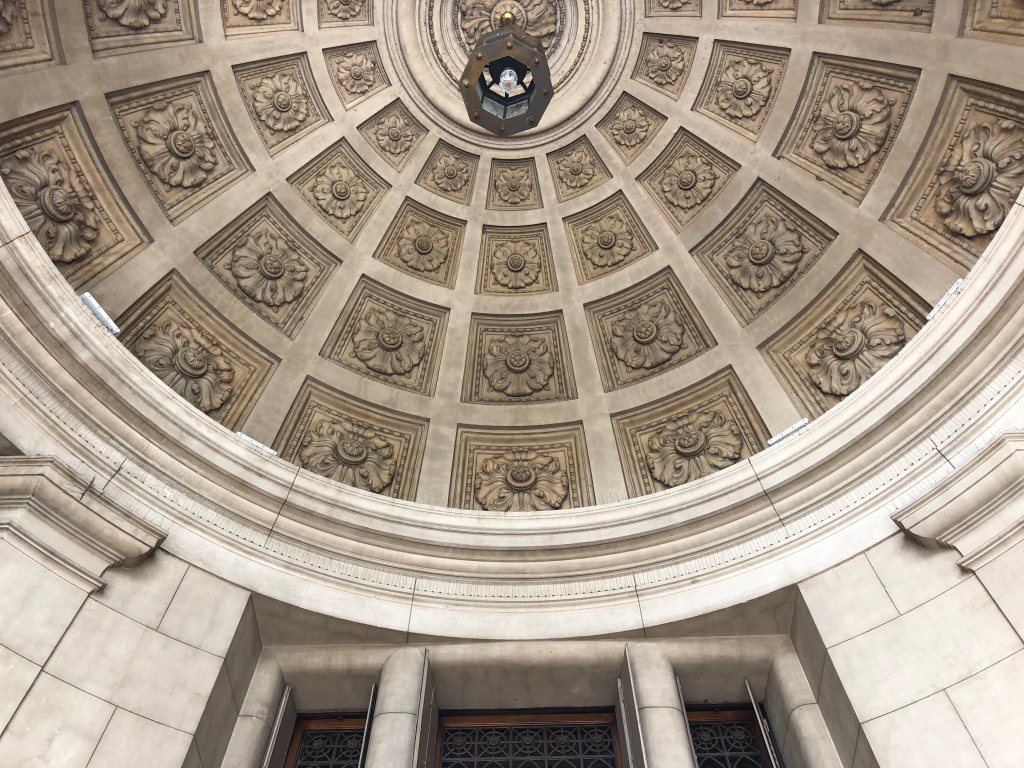
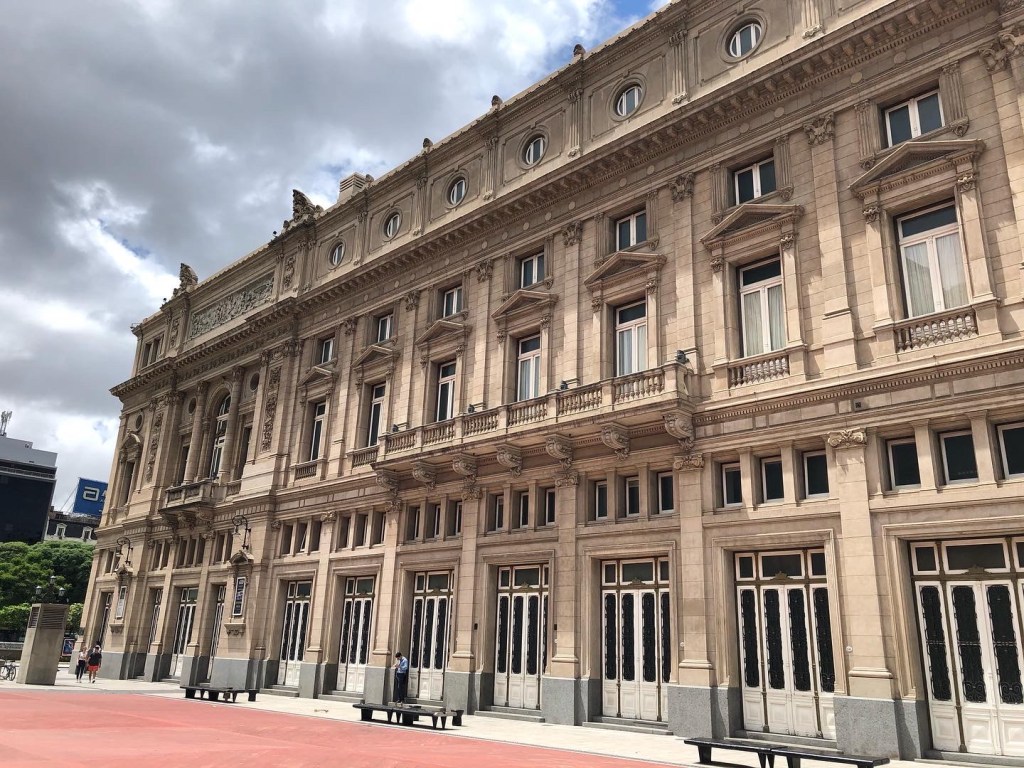
Our first stop was the Teatro Colón, a famous opera theatre in the heart of the city. The theatre is internationally renowned and over a hundred years old. There was the opportunity to join a tour inside but the external architecture is so impressive and we had such a busy day ahead that we pressed onwards.
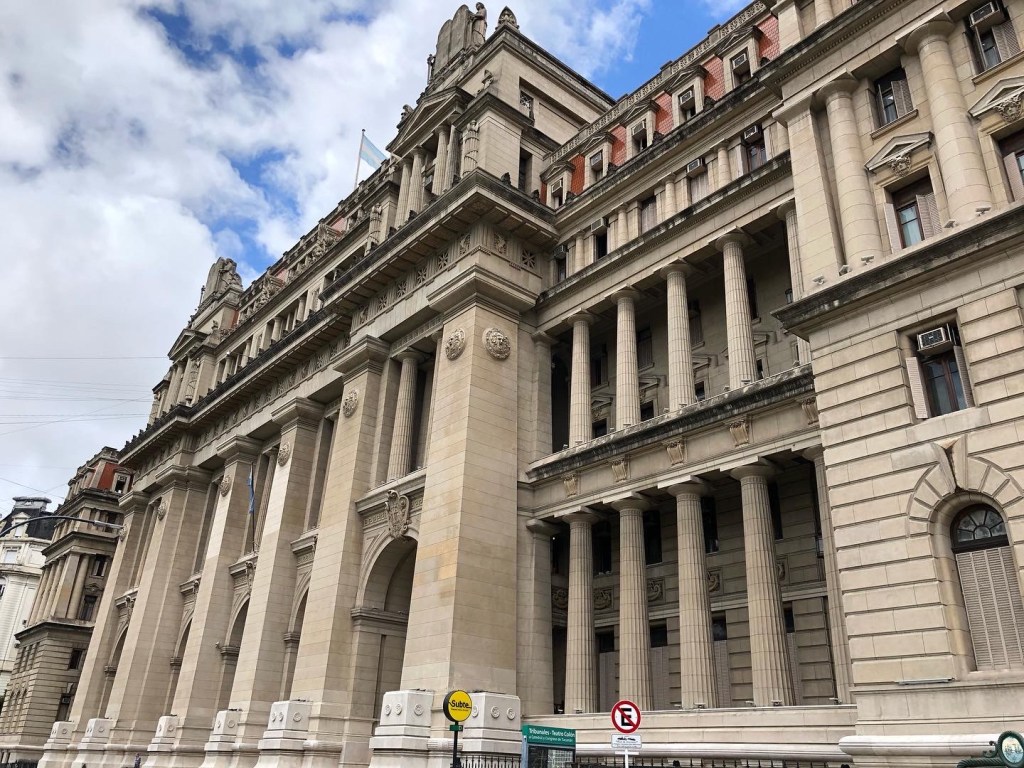
Architecture of Buenos Aires. Teatro Coloñ at the top right and bottom left.
That phrase ‘Paris of the Southern Hemisphere’ really applies to the architecture in Buenos Aires. If you cast your eyes in any direction you’re likely to spot multiple buildings made from stone or that have pillars or domes that it would be socially acceptable to think you are in Europe – at least I think so, as is the nature of Gab Gets Lost. These classic styles are integrated with more modern designs and high rise apartments that give it its unique edge.
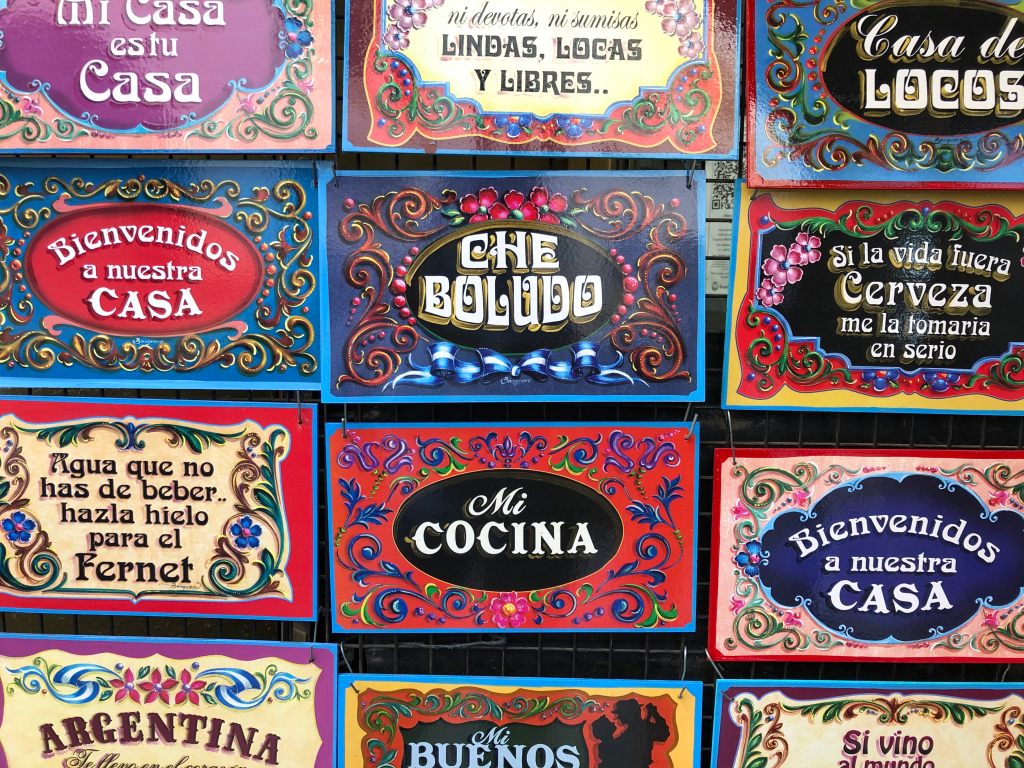
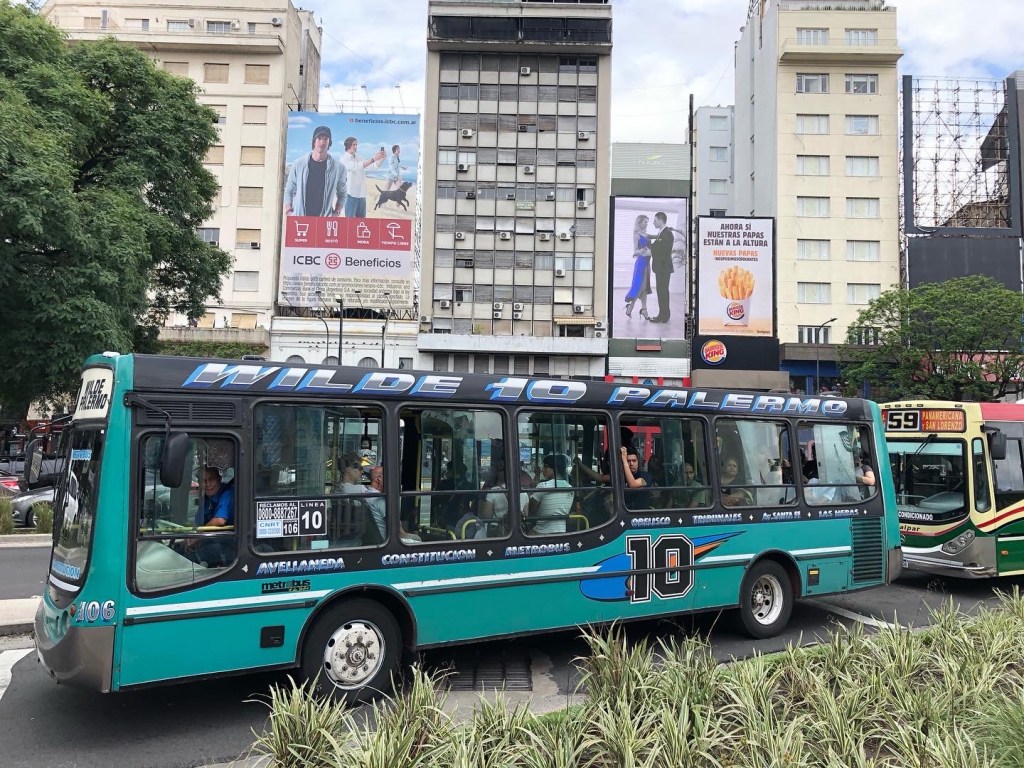
Even Buenos Aires has staked out its own take on public transport. Forget your Opal and your Oyster cards, the light rail and No Shave November moustaches on buses, these designs are actually functional and interesting. Buenos Aires’ unique lettering style Fileteado Porteño took off at the end of the nineteenth Century and is famous for its colourful and stylised designs – think Wild West. Since then, it’s become increasingly popular with tourists and can be purchased on small signs.
But it’s also on the buses! Each bus line has their own colour and has the end destination written in Fileteado style rather than an electronic sign. While the buses are likely all older than Sydney’s, seeing these was like a step back in time and almost made me want to use public transport?
The bus to Palermo in the Northeast of Buenos Aires.
Not quite driven to jump on a bus, we continued down 9 de Julio Avenue. This street was only just surpassed as the widest in the world with nine lanes. Keep in mind that vehicles won’t stop for you at pedestrian crossings, crossing signals don’t make sounds and indicating and driving in one lane at a time is rare, then you might be able to picture the chaos that ensued when we attempted to cross the Avenue!
Halfway over these lanes you can take a break and get a photo with the Obelisk. It stands at almost seventy metres tall and commemorates the quadricentennial of the city’s foundation. It has now become a national icon as it is the site for many protests and football victory celebrations. Given its height and the width of the streets, you can get some great shots all along the 9 de Julio Avenue or climbing to the balconies of multi storey buildings like we did.
Posing outside the Pink Palace with my sister Indigo
Continuing on, we visited the Pink Palace where Eva Peron famously addressed her supporters with the line “Don’t cry for me Argentina!”. She was married to the President and generously increased wages paid to the unions until her death in the 1950’s. The Palace operates as the President’s office and contains a museum of objects from past leaders. We felt that a few photos were sufficient so we hunted down some lunch.
We found a cafe in San Telmo, the oldest neighbourhood in the city. I was able to put the somewhat limited Spanish Duolingo has taught me to good use and ordered an empanada – beef, vegetables and spices wrapped in pastry. Absolutely delicious and seem to be on every menu I’ve seen so far. After lunch we cruised through the streets of San Telmo and bought our own little pot of dulce de leche. We stumbled across a small local antique and food market and found a penguino, a wine decanter shaped as a penguin. I’m hoping this will convince me to buy nice wine more regularly in Sydney!
The San Telmo streets are filled with tango dancers of all levels. We watched a few songs before they started to approach the audience for pictures. Unfortunately I have never been a great dancer so I tried to look discreet. I was a little shocked when I was asked by a dancer to get a picture with him but it turned out to be great fun regardless of whether it looks ‘touristy’.
Typical tango tourists!
We returned to Recoleta a little tired but excited for the tango show in store for the night. Luckily I would only be part of the audience this time! As a complete tango novice, I was really blown away by the show put on at Gala Tango. I could finally understand how one style of dance could be so duplicitous with regular changes in tempo and atmosphere within one performance. Two instrumental acts were completely foreign to me. A man who I thought was playing a ukulele was actually holding the shell of an armadillo with nine strings attached (a charango). Another man was dressed as a typical gaucho and swung his boleadoras, a set of two leather ropes with heavy stones attached to the bottom. He was able to swing them so quickly and with such great force that I thought he might accidentally let go and let them fly across the audience – I’ve posted some great videos on Instagram of the dancers, gaucho and musician. I would compare it to the sounds and rhythm of tap dancing. By 1am we’d successfully lived our first day in Buenos Aires and survived the swinging boleadoras of the tango show.
The opening dance at Gala Tango.
Day One allowed us to tick as many top touristy icons off the list and settle into Argentinean time. As you’ll find out, our second day was a little more structured and allowed us to escape the city for a while and explore the Tigre Islands in the Parana Delta by kayak.
Welcome to the first post for our 2020 trip to South America and Antarctica!
The Pink Palace, Buenos Aires. Left: My sister Indigo
I am writing this from Buenos Aires having spent two full days here already and have finally plucked up the courage to publish the first post on Gab Gets Lost. The Instagram is well underway and the website is ready to go so its time to dive in.
What better way to celebrate the New Year than jumping onto a plane to the other side of the world? My family thought that was pretty hard to beat so over the last couple of years we have been planning our journey through Argentina, Chile, Patagonia and Antarctica. It’s certainly exciting to see our itinerary spring to life around us.
We (Mum) have been working closely with The Classic Safari Company who have greatly helped in coordinating our trip through Argentina and Patagonia. The team is fantastic and have taken us through Botswana and Zambia in 2014 as well as Ecuador and Peru in 2017.
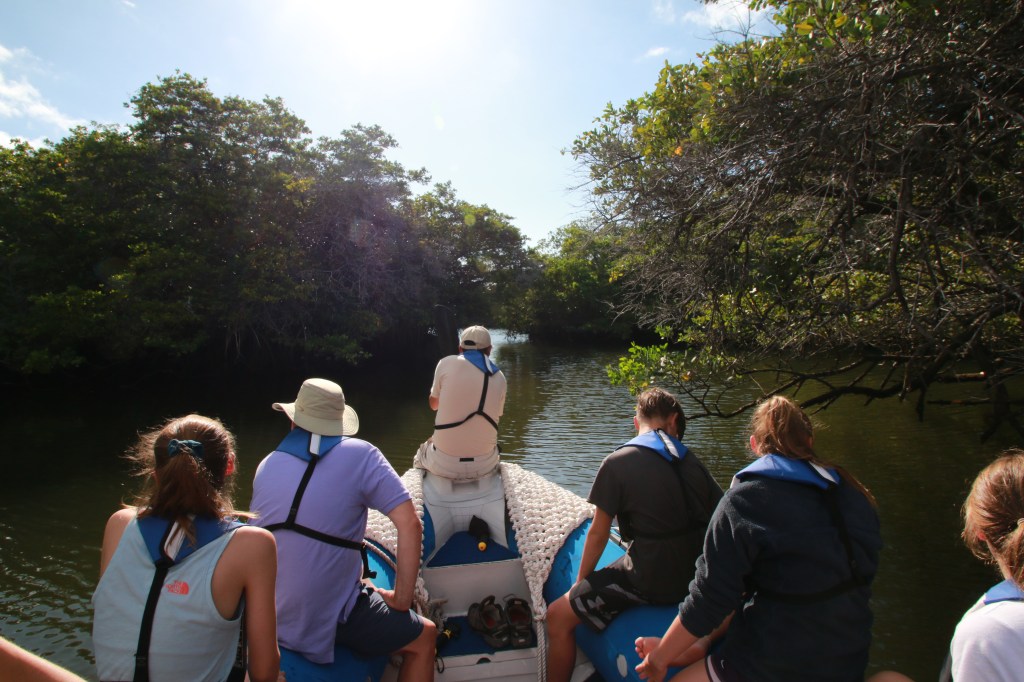
Searching for caiman, stingrays and sharks in the Galapagos Islands, Ecuador 2017.
We enjoyed South America so much we decided to come back as soon as possible. In fact we’re here for the whole month of January, this is what’s in store for us.
The first leg of the trip is set in Buenos Aires. The bustling city is known as the Paris of the Southern Hemisphere but is filled with enough of its own unique Argentinean charms to keep us busy for half a week. The famous Recoleta cemetery, the colourful houses of La Boca, monuments including the Obelisk and Steel Flower and grand buildings like the Teatro Colón are all high on our sightseeing lists. We are also looking forward to kayaking around the Tigre Islands, watching a tango show and consuming lots of steak, wine and empanadas!
Kayaking around the Tigre Islands in the Parana Delta outside of Buenos Aires City.
From Buenos Aires we will fly across to Iguazu for the spectacular waterfalls. After a boat tour on the Argentinean side, we’ll cross the border into Brazil for a different perspective.
Our flight out of Iguazu signals our departure from civilisation as we step into Argentinean Patagonia. At the Southern tip of the continent, we’ll be swapping our summer clothes for hiking gear as we trek up the Perito Moreno glacier.
We will also be spending half a week in Chilean Patagonia at the only lodge within the Torres del Paine National Park. The region is known for its wide plains (or ‘pampas’) that are surrounded by steep mountains, glaciers and lakes. It is home to ‘guanacos’ which are similar to llamas and if we are exceptionally lucky we may spot a puma!
Following our time in Patagonia we will head to Ushuaia, the Southernmost town on Earth. This is where we will join the crew onboard ‘The Greg Mortimer’ and travel to Antarctica. A couple of days later once we’ve traversed the notorious Drake Passage our days (and nights – it won’t get very dark) will be occupied with visiting penguin colonies, whale watching, kayaking through the icebergs and mentally preparing ourselves for taking the polar plunge!
After a month of adventure and gallivanting across the continent I’m sure it will still feel too soon to jump back on that long haul flight home. In the meantime, I’m reminding myself we’re right at the start of our trip and there will always be a reason to come back again! Look out for the recounts of our first few days in Buenos Aires which will be gracing the internet very soon!



























 Gab Gets Lost