
I was excited that we were arriving in Antarctica by boat rather than plane, it added an extra level of anticipation knowing that we would magically pass through the open seas, spot our first icebergs and finally anchor at an island at the bottom of the world. It painted a great picture of just how isolated we would be, in fact we were told that it was easier to bring an astronaut back from the International Space Station than an individual in Antarctica. In fact, I think traversing the Drake Passage is something you could almost boast about because its recognised as one of the roughest patches in the ocean. I’ve never bode well with motion sickness (ironic for a family into travelling) so I was hoping we’d be lucky enough to score a calm trip. The Greg Mortimer’s high tech also includes fantastic stabilisers that help minimise any rocking and its bow helps cut through the waves instead of riding over the top of them. Thank goodness, it looked like we were in for a pretty calm trip for the next day and a half.
There were plenty of activities to keep us busy while we powered towards the Peninsula and I wasn’t prepared to miss out on them. The captain told me green apples were great for travel sickness so I came back to our room to find there was a few extra in my bowl: perfect. Multiple tours of the ship were being run during this time including tours of the bridge which acts as the control centre. Anyone was welcome to join the captain here during the trip and it was a great opportunity to learn what happens behind the scenes.
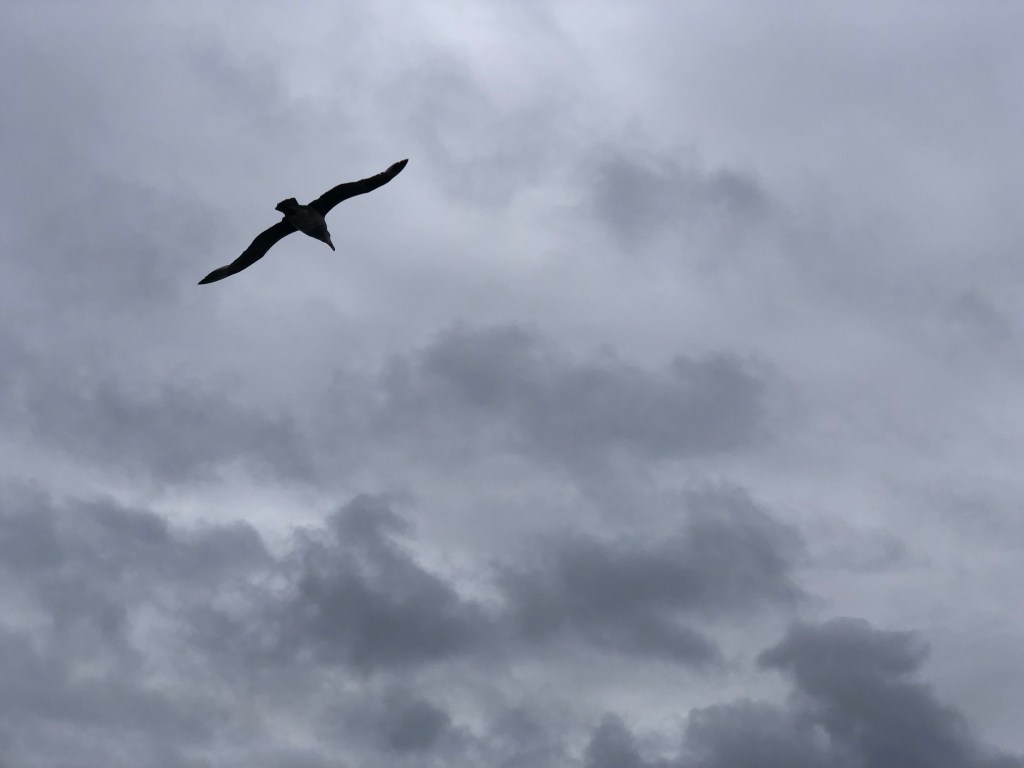
A handful of lectures were given during our time at sea and explored some of the animals we’d meet, the history of the earliest explorers and the politics and international treaties governing Antarctica. One of our more senior guides Heidi was very keen on her birds and introduced us to all the petrels, albatrosses, shags, skuas and gulls. The differences between these birds is fairly subtle but because they often trailed our ship for half an hour or so, we could get a closer look with our binoculars. They never tried to land on the ship and I’m almost sure they liked the company we gave them because we certainly weren’t feeding them! It’s incredible to think that these birds can remain on the wing for so long and have the courage to venture out into some of the world’s most unpredictable environments. The arrival of these birds signalled the start of our wildlife checklist, a communal sheet where everyone could tick an animal or plant species seen that day.
We learnt about the International Association of Antarctic Tour Operators (IAATO) which highlighted the primary biosecurity concerns of visiting the continent and the wildlife watching rules we needed to follow. Unfortunately we weren’t allowed to touch the penguins or go swimming with the whales. A five metre distance between ourselves and any penguins needed to be upheld at all times, which is actually further than you think and we quickly realised this was impossible because they’re such curious creatures. We had to remain twenty metres from elephant seals because apparently they can move pretty quickly (seems unlikely). Whales were a little trickier as they moved around a lot and many were inquisitive and came up to us but I think fifty metres was the general rule. The second half of this briefing was a practical component that mimicked any episode of Border Control. We had to bring any backpacks, shoes, jackets, pants or beanies that we intended to wear over the next ten days to the lecture theatre to be vacuum cleaned. To my embarrassment I had a few nuts from Explora left in my backpack but I eventually earned the all-clear.

The kayakers were also called downstairs to the lockers to get their outfits sorted. I really don’t exaggerate here, it couldn’t be described as anything other than a costume. But I’ll leave that for my next post.
We were informed that a couple of important lists had been added to the bar on Deck Eight. No, it wasn’t the special cocktail list of the night. We’d been at sea for one day but kickstarted an iceberg guessing competition. Everyone was encouraged to place their bet on a time and place where the first berg would be spotted. If you’ve followed along on Instagram then you’ll have noticed that the slabs of ice we first spotted weren’t all that similar to the bergs among the islands. The variety spotted out at sea are tabular and characterised by their gigantic rectangular size and sharp corners. These bergs have fragmented from an ice shelf, which helps give them their geometric shape because the ice has a longer time to set compared to glacial bergs. They can be tens of kilometres across, if not a couple hundred. Given only ten per cent of these giants are above the waterline, it’s nearly impossible to imagine just how much ice lies below the surface.
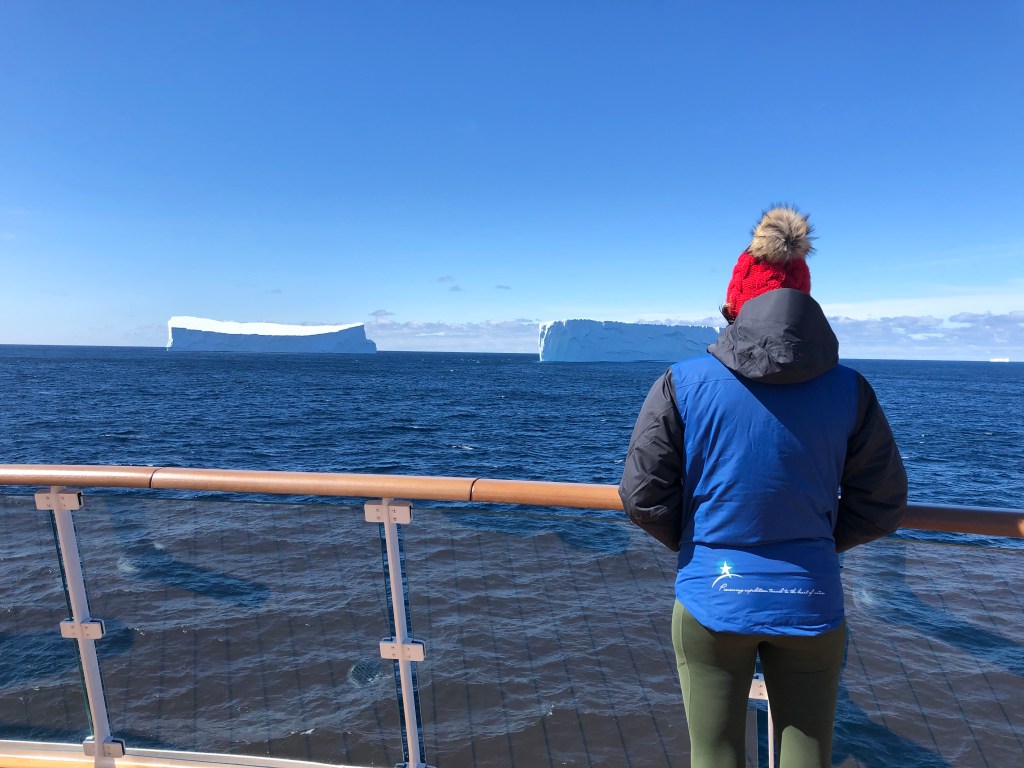
As we started to approach the islands near the Antarctic Peninsula we began to see smaller icebergs with much more abstract shapes. These were the bergs I was looking forward to seeing. However, emerging from the Drake Passage wasn’t exactly what I thought it would be. I imagined coming out of a tunnel and being caught in a blizzard with penguins waddling around in the snow, glaciers in the background. I’ll admit that for a day or two it was pretty similar to that, but our first glance of the continent was a plain rocky island. Penguin Island would be our first point of exploration and it was great fun to kayak around with chinstrap penguins and fur seals. It really subverted my idea of Antarctica, I thought maybe climate change had claimed all the ice (not really) or we’d actually travelled to South Georgia or even a typical English beach.

Keep an eye out for my next post on: kayaking! I can safely say this will be an instalment not to miss, it really made our trip extraordinary.
 Gab Gets Lost